


Goodrich Colombes Sign
When America Could Still Afford European Mastery
Two tire treads float against French vermillion, each rendered in impossible detail. The right shows vertical ribbing, grooves catching light like a bas-relief sculpture. The left displays lateral tread patterns, each rubber knob casting its own tiny shadow. Different scripts. Different designs. Both sculpted in grayscale enamel with such dimensional precision that you instinctively reach out to touch them, certain you'll feel the texture of rubber beneath your fingers.
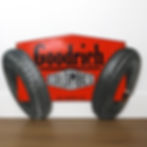
You won't. It's glass. Fused to steel at 800°C (1500° F) through five separate kiln firings¹ by Belgian artisans working in a Parisian enamel workshop, commissioned by an American tire company to advertise their French factory.
No romantic vineyard. No contemplative gentleman. No lifestyle imagery whatsoever.
Just tires. Perfect, sculptural, mesmerizing tires.
And somehow, in 1935, that was enough. The question wasn't "should we make tire treads beautiful?" but "why wouldn't we?"
This Goodrich Colombes sign captures an extraordinary economic moment: the brief window when American corporations could still afford to hire European master craftsmen, when industrial products demanded artisan technique, when the object itself was considered art. Not because anyone was sentimental about craft. Because the market still rewarded the difference.
Within a decade, that calculus would reverse. But not yet.

The Alchemy of Making Tires Beautiful
Two tire treads, two different stories pressed into steel.
The right shows vertical ribbing, "Goodrich" rendered in one script, each groove catching light like carved stone. The left displays lateral tread patterns, a different script, different engineering. Both executed in grayscale enamel with dimensional precision that requires touching to believe.
This wasn't painted. This was built.
The process began with heavy-gauge steel embossed first, with actual physical relief pressed into the metal before a single layer of enamel touched the surface. Then came basse-taille, the jewelry technique where translucent enamel is layered over low-relief engraving.² Light catches differently on raised versus recessed surfaces. The enamel pools deeper in the grooves, creating shadow and depth that shift as you move past the sign.
Then grisaille, the grayscale effect built through multiple layers of glass enamel powder, each fired separately at 800°C (1500°F).³ Light enamel for highlights, darker oxides for shadows. Cobalt for the deep blacks. Gold salts for the vermillion orange that French enamel achieved better than anyone.⁴ Five firings minimum. Each one risking everything; one miscalculation and you start over with new steel, new enamel, new hours.
And those tire treads aren't identical.

Different tread patterns. Different scripts. Each representing a specific Goodrich tire model - the All-Weather versus the Silvertown Cord, perhaps. Each requiring its own embossing die, its own layer calculations. Double the technical complexity for a single sign.
The question isn't whether this required extraordinary skill. The question is why anyone would commission it.
Why jewelry technique for industrial advertising? Why multiple kiln firings when one would create a functional sign? Why two different embossed tire patterns when repetition would cut the cost?
The answer sits at the intersection of economics and belief: because in 1935, someone could still afford to care. And more importantly, customers still noticed the difference.

When America Bought French Excellence
By the 1920s, American rubber companies weren't just exporting tires to Europe - they were building empires. The B.F. Goodrich Company, founded on New Year's Eve 1870 by a Civil War surgeon with a $13,600 loan from Akron investors,⁵ had pioneered relentlessly. First pneumatic automobile tire made in America (1896).⁶ First tires to cross the continent (1903).⁷ The rubber that carried Lindbergh across the Atlantic (1927).⁸
But pioneering in America wasn't enough. The real prize was dominating European markets.
On July 13, 1910, an American businessman named Mr. Work purchased buildings in Colombes, a northwestern suburb of Paris already humming with industrial ambition, and established Société Française B.F. Goodrich.⁹ Eight thousand square meters. Two hundred workers. Within eighteen months, on December 8, 1911, the first French-made Goodrich tire rolled off the line.¹⁰
This wasn't cultural imperialism. This was something more interesting: American companies buying European mastery.
Goodrich didn't just build a factory in France to avoid tariffs. They embedded themselves in French manufacturing culture, hired French engineers, adopted French precision standards, and most tellingly, commissioned French enamel masters to create their advertising.
This sign carries two manufacturer marks, prominently displayed. Neuhaus Paris, founded in 1929 by Jean Neuhaus, "le fabricant basque," whose enamel atelier served Shell, Castrol, Martini, and the most demanding tire companies.¹¹ His partnership with Japy Frères, the industrial concern that controlled 33% of France's enamel production,¹² meant access to specialized glass workshops, rare metallic oxides, and artisans who understood techniques most factories couldn't replicate.

Vitracier Japy, the vitrified steel process that became an industry standard. The capacity to produce 15,000 enamel panels annually by 1953.¹³ The reputation that made dual Neuhaus-Japy marks a quality guarantee.
This wasn't Goodrich hiring a manufacturer. This was Goodrich hiring the best manufacturers. Plural.
Because "Goodrich Colombes" wasn't just an American company making tires in France. It was American innovation wrapped in European legitimacy. American ambition executed with French precision.
The Colombes factory itself embodied this merger. By 1930, it was producing airplane tires for POTEZ 540 military aircraft.¹⁴ By 1935, white-wall tires for France's most prestigious automobiles, the Chambord and the Versailles.¹⁵ French advertisements featured a racing greyhound, all speed and elegance, nothing crude or American about it.
The factory employed thousands in a suburb whose population doubled from 30,000 to 60,000 between 1921 and 1936 as rural workers flooded into industrial jobs.¹⁶ Colombes housed Ericsson telephones, Amiot aircraft, Guerlain perfumes, and the Yves-du-Manoir stadium that hosted the 1924 Summer Olympics.¹⁷
Contemporary accounts noted "hautes cheminées," tall chimneys, constant machinery noise, and sometimes odious factory smells.¹⁸ This was working-class Paris, the "banlieue rouge" that elected communist representatives. December 1937 photographs show Goodrich Colombes workers on strike during the turbulent Front Populaire era.¹⁹
However, Goodrich was still investing heavily in their advertising: Belgian enamel artisans. Multiple kiln firings. Sculptural tire treads that required jewelry-level technique.
Because European craftsmanship was still the gold standard. German lithography, French enamel, Italian marble, these weren't luxuries. They were necessities if you wanted to be taken seriously in European markets.
Goodrich wasn't just selling tires. They were selling American innovation validated by European mastery.

The Reversal
A missing hyphen tells an entire story.
This sign reads "Goodrich Colombes," American name first, no punctuation. By 1938, all Goodrich advertising shifted to "Colombes-Goodrich," French location first, hyphenated.²⁰ Not a typo. A complete identity reversal.
Pre-1938, "Goodrich Colombes" meant an American company manufacturing in France. Colombes as location descriptor. Pride in French production quality. We're so good we conquered their market with their own methods.
Post-1938, "Colombes-Goodrich" meant a French company that happened to be American-owned. Word order reversal plus hyphen creating compound identity. Downplaying American ownership as Europe destabilized. We're actually French, see? Colombes isn't just where we make them.
The shift wasn't about marketing preference. It was about geopolitical survival.
By 1938, French government investment had prompted the renaming.²¹ Germany was mobilizing. France was militarizing. American companies with European operations were playing an increasingly delicate game: How do you maintain market presence as your host country prepares for potential war?
The reversal was a mitigation. A grammatical shift that said: we're with you, not just within your borders.
Which means this sign, with its unapologetic "Goodrich Colombes" ordering, dates to 1930-1937, the last moment of uncomplicated American optimism in France. Before the hedging began. Before the calculations shifted.
Rendered side by side, both tires crafted with equal prominence. The vertical-ribbed tire: classic, traditional, proven. The lateral-treaded tire: innovative, engineered for specific conditions.
Two different strategies. Two different approaches. Both equally valid.
By 1938, Goodrich would be forced to choose which identity to emphasize. But in this sign's moment, both could coexist. American and French. Traditional and innovative. Two treads, two stories, equal weight.
The reversal would eventually force a choice. But not yet.
The Workshop Replaced the Genius
No artist signed this sign.
No "d'après" like advertisements where celebrated illustrators claimed their work. No hidden mark from a master enamelist. Just manufacturer marks. Neuhaus Paris. Vitracier Japy. The companies that made it, not the hands that crafted it.
By the 1930s, that transition was complete. The question wasn't "who painted this?" but "which factory produced it?" Quality was guaranteed by company reputation, not artist recognition.
The craft remained self-evident. The grisaille shading required mastery. The basse-taille embossing demanded precision. The signature wasn't necessary.
This was the Machine Age promise: industry could produce beauty as reliably as it produced function. That you didn't need to know the name of the person who made your tire sign any more than you needed to know who vulcanized your tires. Quality was systemic now. Repeatable. Democratic, even.
The institution guaranteed the quality. The workshop replaced the genius. The refined system replaced unrepeatable inspiration.
How long would institutions continue to guarantee quality? How many cost-cutting meetings before "Neuhaus-level craft" became "Neuhaus-inspired at bargain rates"?
The signature was gone. But the craft remained. For now.

The Irony of Excellence
The Colombes factory thrived through the mid-1930s. White-wall tires for luxury automobiles. Airplane tires for military aircraft. Premium rubber for France's growing middle class, competing against Michelin's patriotic appeal, German engineering, British precision.
Then the war destroyed everything.
Allied forces bombed the Colombes factory regularly during 1942, targeting German-requisitioned industrial capacity.²² After liberation, the company moved its headquarters to Avenue Kléber in Paris, renamed itself Kléber-Colombes, severing the American brand entirely.²³ By 1962, simply "Kléber." Eventually absorbed by Michelin, the very competitor it had fought for decades.²⁴
But what made this sign possible, the economics that justified jewelry technique for tire advertising, was already shifting before the bombs fell.
Post-war enamel production resumed briefly on aluminum instead of heavy steel, then collapsed under economic pressure.²⁵ Lighter materials cost a fraction of vitrified steel. Advertising taxes discouraged outdoor signage.²⁶ Manufacturing standards shifted toward efficiency over durability. Messages simplified. Craft degraded gradually through the 1950s and 60s until it disappeared entirely.
Not because artisans vanished. Not because the technique was forgotten. Because the market stopped rewarding superior quality.
The devastating irony: these signs were so effective, so beautiful, so credible that they taught the entire advertising industry a lesson. Product could be art. Industrial objects could command prestige. Craft could sell.
Which meant companies learned they could achieve the same sales with less craft.
Once enamel signs proved that sculptural tire treads sold tires, cheaper reproductions could ride on that credibility. Once Neuhaus and Japy demonstrated that manufacturer marks guaranteed quality, anonymous factory production could borrow that trust. Once French precision validated American innovation, cost-cutting could replace both.
Excellence succeeded so completely that it made itself obsolete.
The treads are still there, each groove catching light exactly as intended. Your fingers find the grooves instinctively. Each ridge catches the light differently, pools of shadow where the enamel settled deeper during firing. You know it's glass - you've been told it's glass - but your hand still expects the give of rubber.
Then you lift it, heavier than you anticipated. Solid. Permanent.
Ten pounds of steel and glass, built to hang outside a Parisian tire shop for decades without considering weather or obsolescence. Someone in 1935 commissioned jewelry technique to sell tires - and proved so completely that it worked that the market learned craft was optional. Just the aesthetic mattered. Just the sale.
First, the signs got cheaper. Then the tires. Then everything else.
We're astonishingly good at solving problems now. We don't worry about surviving winter. We worry about software updates. And somehow, in that security, permanence became the thing we stopped building for entirely.
Sources:
Porcelain enamel firing temperatures and multi-firing techniques documented in French enamel sign production records, 1920s-1930s
Basse-taille technique definition and application from French decorative arts documentation
Grisaille enamel technique specifications from industrial enamel production manuals
Metallic oxide formulations for enamel colors from French enamel manufacturer technical documentation
B.F. Goodrich Company founding details, December 31, 1870, from Encyclopedia Britannica and company records
First U.S. pneumatic automobile tire, 1896, B.F. Goodrich Company history
First transcontinental automobile journey on Goodrich tires, 1903 (Winton vehicle)
Charles Lindbergh's Spirit of St. Louis aircraft equipped with Goodrich rubber, 1927
Société Française B.F. Goodrich establishment, July 13, 1910, from Kleber.fr official corporate history
First Goodrich tire produced at Colombes facility, December 8, 1911, from Kleber.fr corporate history
Jean Neuhaus ("le fabricant basque") founding of enamel atelier, 1929, from memoire-signalisation.fr and French trademark records
Neuhaus-Japy Frères partnership (1934-1979) controlling 33% of French enamel production, from memoire-signalisation.fr and auction documentation
Neuhaus production capacity at Béhobie factory, 15,000 panels annually by 1953, from company records
Goodrich Colombes production of POTEZ 540 aircraft tires, 1930, from Kleber.fr corporate history
Goodrich white-wall tire production for luxury automobiles (Chambord, Versailles), 1935, from Kleber.fr
Colombes population growth from 30,000 to 60,000 (1921-1936), from French patrimoine records
Colombes hosting 1924 Summer Olympics at Yves-du-Manoir stadium, from Olympic historical records
Contemporary descriptions of Colombes industrial character from French historical documentation
Goodrich Colombes worker strikes, December 1937, from Front Populaire era photography and labor history records
Goodrich rebranding to "Colombes-Goodrich" with hyphen and reversed word order, 1938, from Kleber.fr corporate history
French government investment prompting 1938 renaming, from Kleber.fr and Jalopnik automotive history
Allied bombing of Colombes factory, 1942, from Kleber.fr corporate history and WWII industrial target documentation
Post-liberation relocation to Avenue Kléber and renaming to "Kléber-Colombes," 1944, from Kleber.fr
Michelin acquisition of Kléber (1981) and BFGoodrich tire business (1988-1990), from corporate merger documentation
Post-war shift from steel to aluminum enamel sign production documented in French industrial manufacturing records
French advertising taxation on outdoor signage, 1960s, from French commercial law documentation
The Colombes factory learned that jewelry technique could sell tires, and the whole industry learned with it - and then learned the lesson's second half, that once excellence is legible, it can be imitated cheaply enough to make the original economically obsolete. The Ferrari Cavallino Rampante sign is what it looks like when one man refuses to let that mechanism finish its work. Enzo spent sixty-five years building cars that weren't quite good enough for the gods, not because the market demanded it, but because he was cursed with seeing the gap. Both signs rest in The Collection, among the objects that record what the twentieth century kept asking of craft: prove you're excellent enough that we can stop paying for excellence.
FOR THE HISTORY SCHOLAR
This artifact defines the precise economic moment when American corporations could still afford European mastery. Pre-1938 "Goodrich Colombes" word order proves manufacturing before geopolitical hedging began, before the hyphen appeared and French location moved first to survive destabilization. Neuhaus-Japy dual marks guarantee basse-taille embossing and grisaille technique requiring five separate kiln firings at 800°C (1500°F) - jewelry-level craft commissioned for industrial advertising. The devastating irony: excellence proved so completely that craft could sell, the market learned cheaper reproductions could achieve same results. First advertising degraded, then products followed. This captures American innovation wrapped in European legitimacy, the brief window when permanence was assumed rather than negotiated, before craft became optional and disposability became strategic.
FOR THE STRATEGIC COLLECTOR
You're collecting the moment when institutions guaranteed quality and systems replaced individual genius. Dual Neuhaus-Japy manufacturer marks authenticate both artisan technique and industrial capacity - a partnership controlling 33% of French enamel production, 15,000 panels annually. The dual tire treads with different embossed patterns double the technical complexity, separate dies for each model requiring separate layer calculations. Pre-1938 dating via word order creates rarity: after French government investment prompted renaming, all signage became "Colombes-Goodrich" with hyphen. The ten pounds you're lifting represents someone choosing five firings over one, sculpture over function, permanence over efficiency. Displayed with modern disposable products, the weight difference devastates. What are we building now that's meant for 2126?
FOR THE INTERIOR DESIGNER
This transforms industrial advertising into dimensional sculpture. Your fingers find those tire grooves instinctively because basse-taille embossing creates actual physical relief beneath translucent enamel layers - light pools differently in recesses versus raised surfaces, shadows shifting as you move past the sign. Grisaille grayscale built through multiple glass powder firings achieves depth photography couldn't replicate until decades later. French vermillion orange shows why European enamel commanded premium: metallic oxide formulations American factories couldn't match. The composition balances dual treads with equal visual weight, neither subordinate, both perfectly detailed. In sophisticated spaces this doesn't just hang, it COMMANDS - ten pounds of permanence built to outlast weather, vandalism, obsolescence. Product elevated to art before marketing learned art was optional.
FOR THE PASSIONATE ENTHUSIAST
Touch those treads. Your hand expects rubber, finds glass, lifts ten pounds heavier than anticipated. Someone in 1935 commissioned jewelry technique to advertise tires, proved so completely that craft could sell that the market learned a devastating lesson: just the aesthetic mattered, just the sale. First the signs got cheaper. Then the tires. Then everything else. We're astonishingly good at solving problems now - we don't worry about surviving winter, we worry about software updates. And somehow, in gaining that security, permanence became the thing we stopped building for entirely. But here's what makes this sign extraordinary: creating beauty this precise, this dimensional, this expensive for something as utilitarian as tires required a very specific collision of forces. American ambition. French manufacturing excellence. Belgian enamel mastery. And an economic moment when craft still mattered more than cost.

OTHER STORIES FROM THE COLLECTION


ADDRESS
North + South Carolina
U.S.A.


