Why Don't They Make 'Em Like They Used To?
The barn was coming down. It was an old wooden one in the mountains, its boards gone gray with age, its metal roof rusted solid orange and already falling in where it had sagged the longest.
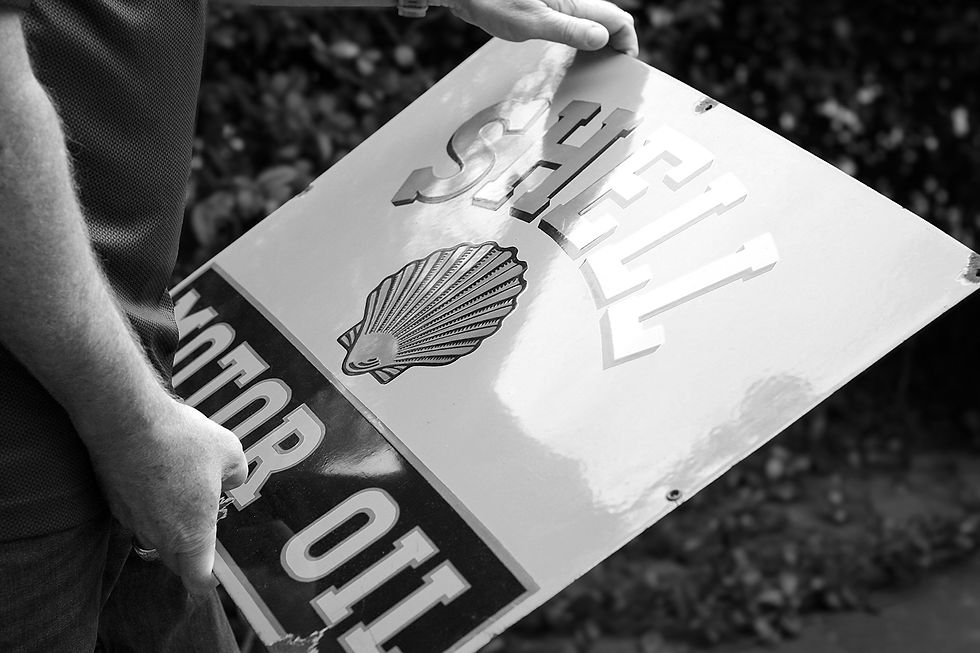
Two Atlantic signs were patching that roof, screwed down tight. You can’t nail through porcelain. Whoever covered those holes must have known what he had. Free, or close to it, and better than anything sold at the hardware store.
Robert backed them out one screw at a time, alone on a ladder with a screw gun, holding a heavy sheet of steel and glass over his head. Anyone who has done it knows there are two things you’re trying not to drop, and one of them is you.
Both were whole, never cut to fit. They’d been put face down, and under the grime, the color was still there. A few chips, a good cleaning, and they’d grade near an 8, maybe better. The roof they’d been holding together had given way around them.
The last thing standing on that barn was an advertisement.
Most signs that reach a show have hung in three places.
The first was the one they were made for: a station, a general store, a feed mill, somewhere a company paid to put its name. Then the station closed, or the company changed its look, and the sign came down. Nobody wanted it, so it was given away, or leaned behind a shed, or dumped in a ditch, until somebody needed to patch a roof, or somebody with a business of his own painted right over it.
That’s how a 1950s gas station sign ends up on a chicken coop.
Then, slowly, the signs became worth something. Pickers started driving the back roads and knocking on doors. A farmer learned that the patch on his barn had a price, and the sign came down a second time, on purpose now, headed for somebody’s wall. Every so often Robert could trace one back to the building it was made for, a few miles from where he found it. By then, the building was usually gone, but more often than not, the pole remained.
Not every sign made the trip whole. Most of the ones that went onto a barn were cut to fit whatever space a man had to cover: a corner of an outbuilding, a gap under an eave, the top of a shed door. They still turn up at every show, with an edge that runs off at a strange angle or a notch where a beam once sat.
Every odd edge is the outline of somebody’s roof.
In 1994, a writer named Stewart Brand published How Buildings Learn, a book about what happens to buildings after the architects leave. He borrowed an idea from the architect Frank Duffy and called it shearing layers: a building is really several layers, each wearing out and getting replaced on its own clock.
Picture an old gas station. The lot is the slowest layer, and Brand put it in three words: “Site is eternal.” The foundation and the walls that hold the place up might stand anywhere from 30 to 300 years. The outside, the paint and trim and the face it shows the road, gets redone every twenty years or so. Inside, the coolers, the shelves, and the counter change faster still.
A sign lives on the skin. It’s the first thing a new owner takes down. By Brand’s logic, it should have been the first thing to go.
Instead, you can see the layers come apart from the road. A concrete pad with weeds growing up through the seams. A pole still standing at the edge of the lot, shaped so that anyone who knows can tell you whether it held a Gulf or a Texaco. The building is gone, the pumps are gone, the canopy is gone. The site is still there, and the sign is three homes away on somebody’s wall.
The usual explanation is that nobody cares anymore. Plenty of people do. The rules they built under were written for something else.
In 1932, deep in the Depression, a New York real estate broker named Bernard London published a pamphlet called Ending the Depression Through Planned Obsolescence. The trouble, as he saw it, was that frightened people were using everything they owned longer than they used to. His cure was to give every product a lifespan and declare it legally dead when that time ran out. He wanted the country to conscript “the dead things,” old buildings included, and send them off to be destroyed. People everywhere, he complained, were “disobeying the law of obsolescence.” That same year, Buy American was running across Hearst’s newspapers.
London never got his law. He didn’t need it.
Today, the federal tax code lets a qualifying gas station write off its entire building in fifteen years. An ordinary commercial building takes thirty-nine. Towns eager for new business offer property tax breaks, often written for new construction. And when a big retailer moves into its new building down the road, the deed on its old one can bar a competitor from moving in for twenty-five years, sometimes fifty. You’ve seen the pair all over the Southeast: the new building on one side of the interstate, its predecessor dark on the other.
I’m not above any of it. Robert and I spent years pricing a metal barndominium, and I never could stop wondering what all that metal would look like in thirty years.
The country now owes more than $40 trillion. We’re borrowing to build what we’ve already scheduled to throw away.
Signs like the ones on that barn had makers, even if nobody on the farm ever knew their names.
In 1887, a small department on the grounds of a steel company in Beaver Falls, Pennsylvania, began making porcelain enamel signs. Two Englishmen, Louis Ingram and Ernest Richardson, already knew the trade, and in 1901 they organized the company that took their names.
Within thirty-five years, Ingram-Richardson was the largest of its kind in the country, enameling signs, stoves, sinks, and tabletops, and in 1934 it moved the trade to silk screen. Two men had carried a craft across an ocean, and a river town in Pennsylvania made it its own.
Sam Frederick was fourteen in 1909 when his brother Charles hired him into the company’s art department. His father and four brothers worked there too. Sam stayed fifty-one years, forty-five of them running that department, and he put it simply: “We were proud of the company product.”
In April 1964, after a strike, the board recommended closing the plant. It still employed 135 people on the production floor and 25 in the office. Operations stopped in March 1967, and on November 29 of that year, Ingram-Richardson officially closed. Whatever those people knew in their hands went home with them.
Almost no American alive today has watched a porcelain sign being made.
I was late to this. By the time Robert and I were picking together, signs like those Atlantics were drying up in the wild, and I only got to go along for a few. I remember my rain boots and red mud, wasp nests in every corner, and once, Robert falling through a rotten second-story floor. And I remember the Windex: thirty, forty, fifty years of dirt coming off a sign until the gloss came back, in layers and then all at once.
Now almost nobody pulls a sign off a barn. It goes from a dealer to a collector to an auction house to another dealer, and the lines between them blur, because most of us have been all of those at one time or another. With every trip, it moves a little farther from the station it was made for, and the factory that made it is gone.
What it has left is the people who keep it. The farmer who drilled it onto his roof. Robert, alone on a ladder. Whoever hangs it on a wall next, and the person after that.
Nobody designed any of it. It happened one person at a time, each of them looking at a piece of old steel and deciding it was worth one more room.
- Liz Smith
Sources:
Stewart Brand, How Buildings Learn: What Happens After They’re Built, 1994
Bernard London, Ending the Depression Through Planned Obsolescence, 1932
Sen. Maria Cantwell, letter to the FTC on grocery restrictive covenants, May 6, 2026
Boondoggle, “The New Race to Take on Food and Pharmacy Deserts”
U.S. Treasury, Debt to the Penny: $40,305,316,210,829.72, October 8, 2026
Beaver County Historical Research & Landmarks Foundation, “Ing-Rich Was Largest of its Kind in Beaver County”
Joe Tronzo, “Signmaker Looks Back: Reflections of Ing-Rich”