


Would You Stop Here If You Were Just Passing Through?
The drive home from Hershey runs through some of the most beautiful country we have. Ridge after ridge of it, the color a little further along than it had been in the field, the light doing what October light does in the mountains.
We stopped where everyone stops. Gas, coffee, a Starbucks off one exit, then another a few hundred miles later that I couldn't have told apart from the first. Somewhere along the way, I started reading the blue signs.
You know the ones. A board of logos before every exit, telling you where to eat and where to buy gas. The same companies, in the same order, from Pennsylvania to North Carolina.
The mountains changed the whole way down. The signs never did.
Exit 67 is the last exit in North Carolina, or the first, depending on which way you're headed. Either way, it's the first thing the state shows you.
You come off the ramp between two traffic circles, one on each side of the bridge. Each has a single tree and a bed of river rock gone to weeds. Every ten years or so, somebody beautifies them, and then nobody touches them until they need beautifying again. The grassy slopes along the ramps are the same story. In thirty years, I've watched them torn up, replanted, and left to grow over at least three times. We spend money to not maintain.
There are four gas stations, one on every corner. One shares its lot with a Chinese restaurant in what used to be a Burger King. One is lit up like a carnival, selling vapes. Across the interstate, one has closed for good and sells storage sheds out of its parking lot, and the last is headed the same way. I'm honestly not sure the pumps work.
A Tractor Supply lives in an old Bi-Lo. A Taco Bell sits closed. Toward Columbus, a Mexican restaurant has moved into an old Hardee's, and the building still says Hardee's even where the sign doesn't. Down the road, an empty sign frame stands over the shoulder, two posts and a rectangle of nothing, waiting for the next tenant.
Every one of these buildings was built to be a brand. When the brand leaves, the building can't become anything else, so the next tenant just wears the costume.
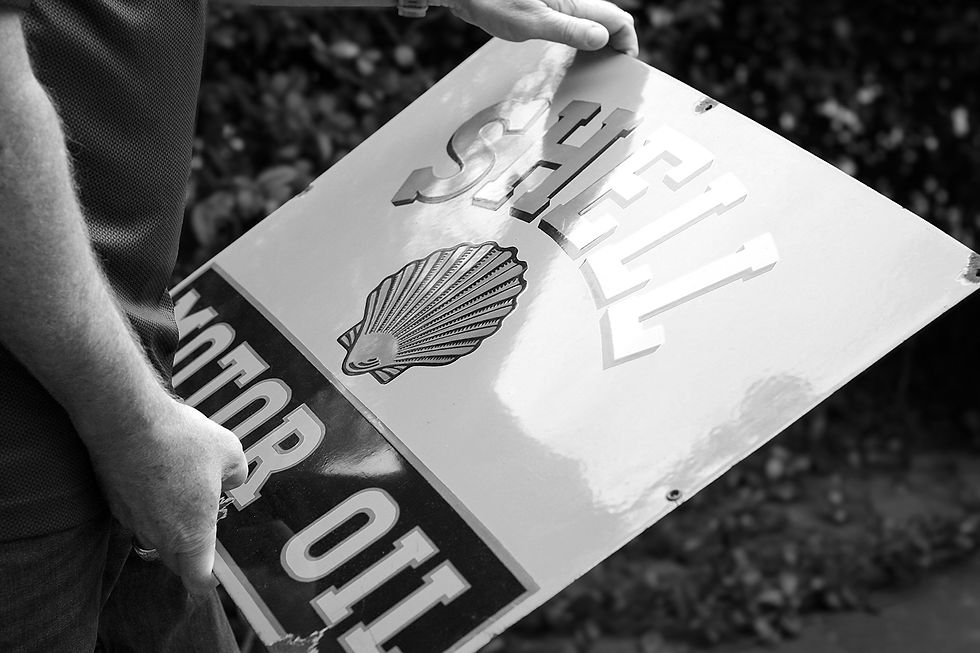
Any collector will tell you a Texaco is a Texaco from Maine to Texas. Nothing at Exit 67 existed only here. It could be any exit in America, and not one thing about it tells you Tryon is two miles away.
The bank is the only decent building.
Two miles later, you're on Trade Street, and it's another world.
Brick storefronts, two and three stories tall, standing shoulder to shoulder. Cornices along the rooflines, awnings over the sidewalks. The railroad runs alongside the town, higher than the street, and from up by the tracks you get the best view in Tryon: rooftops, then mountains. The old Tryon Theater has been redone, and so have several of its neighbors.
None of it is fancy, which is what surprised me the first time I really looked. These buildings are boxes, plain and sturdy, with good bones and a door in front. Over the years they've held restaurants, shops, coffee shops, and dentists' and attorneys' offices, and they'll hold something else after that. It's still hard to make it here. The revival has rested on a handful of people, and businesses rotate in and out, though more slowly than they used to. But when a tenant leaves Trade Street, the building is still a building. It doesn't have to wear anyone's costume.
People love towns like this and call it nostalgia. Collectors hear the same thing about our signs, that we just like old stuff. We don't, really. We like things that were built well: beautiful, practical, and a little ornate, made by someone who expected them to last. A porcelain sign from the 1930s and a brick storefront on Trade Street are the same idea, just at different scales.
Old is just what well-made looks like after enough time.
Time does something else, too. It makes whatever we inherit look normal.
In 1995, a fisheries scientist named Daniel Pauly noticed that each generation of researchers judged the ocean against the way it looked when their own careers began. Every generation's starting point was a little emptier than the last, and nobody felt the loss, because nobody remembered further back than themselves. He called it shifting baseline syndrome. Somewhere right now, a kid riding past Exit 67 is learning what an exit looks like. Maybe what a town looks like.
You could forgive all of it if the exit at least paid its way. It doesn't.
On that same trip, rerouted in the dark somewhere around Rutherfordton, we passed three Dollar Generals in about a square mile, their yellow signs the only light on the road. A town runs on what its land is worth on the tax rolls; that's what pays for the roads, the fire trucks, the library. When the firm Urban3 measured that value across eighteen counties in western North Carolina, an acre under an average Dollar General came out to about $604,000, and an acre under an average McDonald's about $1.1 million. An acre of downtown, even an unglamorous one, tends to run over $5 million. Acre for acre, the brick boxes on Trade Street carry the town. The exit barely carries itself.
When I lived in Europe, I assumed their towns had simply always been intentionally beautiful. They hadn't. They tore down their share of shoddy buildings, too. The difference is what went up next. They replaced with better. We replace with cheaper.
It had been a year since I'd driven that exit.
And then, two miles in, there's Morris.
He's a wooden horse, white with black dapples and a red saddle, and he started as a toy. In 1915, Eleanor Vance and Charlotte Yale, two women brought to these mountains by the Vanderbilts to teach wood carving, moved their workshop to Tryon. Their toy horses went out all over the country. In 1928, the shop built a giant one to advertise the horse show. A fire destroyed him, and the town built him again, and again. The one standing now is the fifth.
He stands where Tryon began. The town was laid out in a half-mile circle around the corner of Pacolet Street and the railroad, and Morris marks the spot. For a long time, this was the front door. You stepped off the train and the town was right there to meet you, with shops and a meal a few steps away.
Everyone arrives at Exit 67 now. It’s the front door, and nobody ever built it a porch.
Both places get rebuilt, over and over. The exit, because nobody kept it up. Morris, because nobody could stand to lose him.
- Liz Smith
Sources:
Daniel Pauly, "Anecdotes and the Shifting Baseline Syndrome of Fisheries," Trends in Ecology & Evolution, 1995
Strong Towns, "Main Street vs. Big Box Stores: A Western North Carolina Analysis", 2022
Tryon Daily Bulletin, "Remember When: Evolution of the Tryon Horse"
Our State, "Tryon's Morris the Horse"
North Carolina General Assembly, resolution honoring the Town of Tryon


Comments