Where Do You Even Find These?
Someone asks Robert at nearly every show, usually standing in front of something European. He has a short answer and a long one. The long one starts more than fifteen years ago, in a folding chair, at an auction we were only attending for a friend.
Auctions are boring. I’m sorry, but they are. From the podium, they’re theater. From the audience, they’re an afternoon of lot numbers, the chant rolling on and on, and the sodas going warm under your seat. Robert called auctions of his own, which made sitting through somebody else’s a particular penance.
So he went shopping.
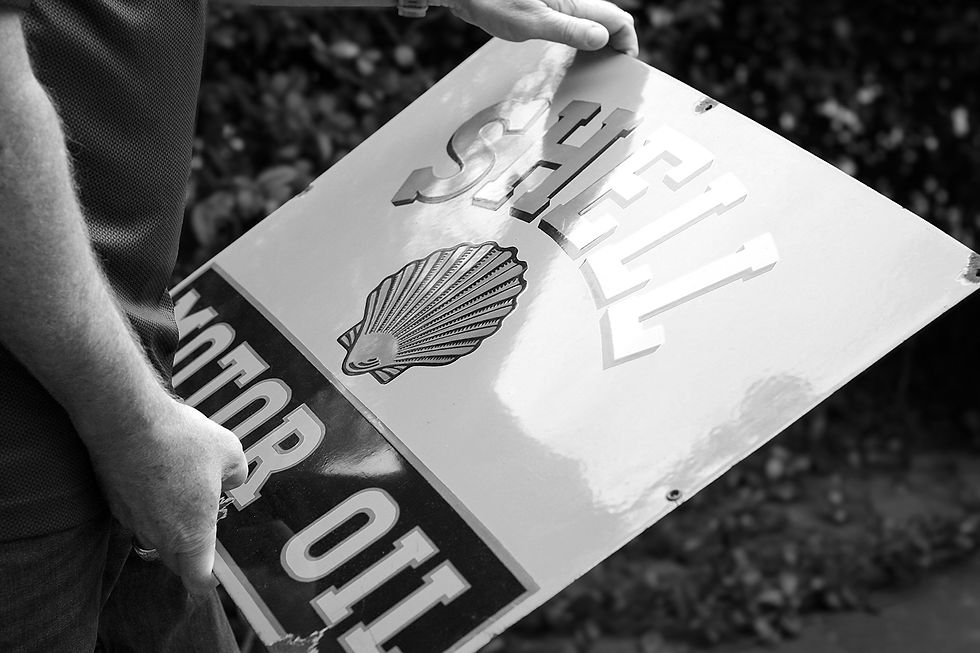
He was buying for his own sale, scrolling eBay from a seat near the back, in the middle, while another man’s inventory went across the block. In those days you could reach a seller in a couple of clicks, and he found one in Italy with a Mobil tombstone.
There wasn’t a word of Italian on it. Same name, same shape, a sign he’d have bought at any auction in the Carolinas without a second thought.
The seller wrote back in English that came in pieces. A few words, a pause, a few more. Robert answered, and the seller answered, and they went back and forth like that for a while, two men working hard to say very little.
Then Robert turned to me, keeping the screen low so nobody else could see.
“Should I?”
“Why in God’s green Earth wouldn’t you?”
I’d like to call that wisdom. It was mostly geography. I had lived in Europe, and a message from Italy in broken English didn’t look foreign to me. It looked like someone I might have sat across from on a train.
Robert had spent his whole career reading men across a room: who was serious, who was bluffing, who had one more bid left in him. This man he couldn’t read at all. There was no room and no face, only a screen.
The sign, meanwhile, was the most familiar thing in the deal, a Mobil, a name he’d known his whole working life.
The man was the only stranger in it.
Americans used to be proud to buy foreign.
Up the road in Asheville, George Vanderbilt began Biltmore in 1889, and while it went up, he and his architect, Richard Morris Hunt, traveled Europe buying what would fill it: paintings, furniture, carpets, porcelain, bronzes, Flemish tapestries woven in the 1500s, and a ceiling painting from a Venetian palace. The most storied piece arrived by way of an auction. It was Napoleon’s game table from his exile on St. Helena, the same table where, after his autopsy, his heart was set down in a silver urn. An upholsterer who had been in the room bought it, and in 1883 James McHenry gave it to Vanderbilt for his twenty-first birthday.
In 1930, in the middle of the Depression, Asheville’s business community asked the family to open the doors to visitors. A house full of Europe became the thing people drove to the mountains to see. It was the same family that brought Eleanor Vance and Charlotte Yale here to teach wood carving, which is how Tryon eventually got its horse.
And then there was Robert, in a folding chair, asking whether a Mobil sign from Italy was safe to buy.
He bought it, of course, and the man on the other end turned out to be young and very kind.
The messages kept coming after that. One sign became another, then another, and the Mobil tombstone he almost talked himself out of became the start of the European side of the business.
For more than twelve years, that was the whole relationship: a screen, a few words at a time, and a sign at the end of it. Robert trusted him by then. He still had never been in the room to read him.
Then we went to Italy. Across a café table, Robert finally got to read the man the way he reads everyone, and there was nothing left to find. They were both laughing before anyone ordered, stumbling through two broken languages.
We have stayed in his guest house since. He has shared his knowledge, his finds, and his home.
Somewhere, on someone’s wall, hangs a Pegasus that came home the long way, through the door one “Should I?” opened.
So when someone asks Robert where he even finds these, he usually gives the short answer. The long one is a young man who wrote back, and a wife who asked why not.
- Liz Smith
Sources:
Biltmore, “Collection Highlights”
Biltmore, “The Emperor’s Chess Set”
Biltmore, “Estate Timeline”