


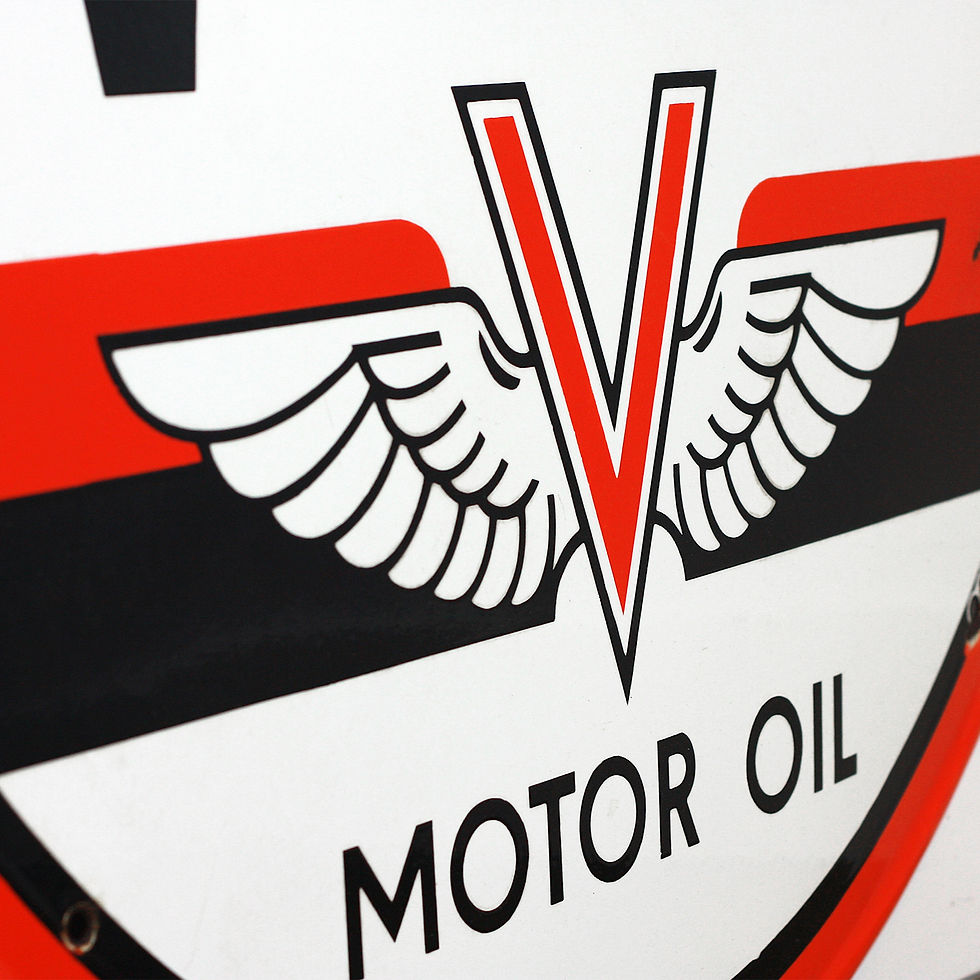
Veedol Flying A Sign
The Invisible Partner
Somewhere in America. Early 1920s. A dirt road. A Model T. A woman learning to drive for the first time.
Her father beside her, patient: "Gentle on the pedal. Feel how it responds."
Her delicate right foot finds the brass accelerator, cool at first, warming under her touch. She presses, tentative, watching his face. The engine answers with a low, smooth hum, and the car moves forward beneath her. She gasps. Then laughs - the surprised laugh of someone who didn't quite believe it would work until it did. Her hands tighten around the steering wheel, the real weight of wood and brass, something solid to hold.
"That's it," he says. "You're driving."
She was. Herself. No horse. No man between her and the road. Just the open track ahead and a machine responding to the lightest pressure of her foot.
What nobody told her was that the smoothness she felt wasn't accidental. It was chemistry, a specialized lubricant called Forzol, formulated specifically for the Model T's engine, reducing the friction between moving metal surfaces so precisely that a woman with no mechanical training could press an accelerator for the first time and feel the car simply obey. Between 1914 and 1927, that same invisible chemistry made that same moment possible for 15 million people.⁵
Henry Ford assembled the cars. Veedol made them run.
Ford got the front page. Veedol got the footnote.
The Company That Built Underground
Before Veedol was a brand, it was a philosophy.
Byron D. Benson founded the Tide-Water Pipe Company in 1878 with a specific problem to solve: Standard Oil controlled the railroads, and the railroads controlled oil transport. Every Pennsylvania oil producer was at Rockefeller's mercy.¹ Benson's solution was to go beneath all of it, a 110-mile (177-kilometer) underground pipeline from the Pennsylvania oil fields to Williamsport, the first long-distance oil pipeline in history.² Invisible, unblockable, finished before Standard Oil fully understood the threat.
The Tide Water Oil Company that grew from Benson's underground gamble, was in the invisible infrastructure business from its first day. By 1913, when it created the Veedol lubricants brand, that instinct was already institutional.³ Veedol didn't sell flash. It sold function. It found what needed to be done quietly and did it.
Henry Ford understood immediately. The Model T's combined engine-and-planetary-transmission sump was a bottleneck that threatened mass production itself. Early lubricants couldn't sustain the repeated, continuous use the assembly line demanded. Engines seized. Overheated. Failed at scale. Veedol developed Forzol for the Model T specifically, then, critically, didn't hoard it. Shared the solution with Ford. Enabled the dream at scale.⁴
Fifteen million Model Ts.⁵ Rural America connected. Women driving themselves to town for the first time. Farmers transporting their own goods. An entire country in motion.
The oil that made it possible was drained every few thousand miles and thrown away.
776 Feet of Invisible Partnership
October 1928. Friedrichshafen, Germany.
The LZ 127 Graf Zeppelin, 776 feet (237 meters) long, hydrogen-filled, the largest aircraft ever built, prepares for its inaugural transatlantic passenger crossing.⁶ Twenty passengers aboard. Six thousand miles of open ocean ahead. No emergency landing possible if anything failed.
The ship's five Maybach VL-2 engines would run continuously for 111 hours to carry those passengers from Germany to New Jersey.⁷ The following year, under the command of Hugo Eckener, one of the most celebrated aviators of his era, the Graf Zeppelin circumnavigated the globe. Over its operational life, the airship made 590 flights and crossed the Atlantic 144 times, carrying 13,110 passengers without a single fatality.⁸
The oil in every one of those engines was Veedol.⁹
Veedol had opened a Hamburg office three years earlier, in 1925.¹⁰ Germany was a natural market, the German engineering and automotive industries were among the most sophisticated in the world, and Veedol positioned itself as the oil that matched that standard. From that same Hamburg, a generation later, a 39-inch (99-centimeter) round porcelain sign would emerge from Stanz- und Emaillierfabrik Klimo & Bongartz GmbH in Hamburg-Wandsbek, American oil rendered in German steel and glass, hung on the walls of the Tankstellen rebuilding across postwar Germany.¹¹
The Zeppelin relationship wasn't incidental. In 1936, when the Hindenburg made its maiden voyage across the Atlantic, Alfred Ernst of the Tidewater Oil Company was aboard as a passenger, the oil company's man, there to formalize Veedol's supply relationship with the German airship program.¹² He sat in the passenger lounge above the clouds, the hum of diesel engines overhead, flying on behalf of an American oil brand into the complicated air of 1930s Europe.
Every newspaper in the world photographed the Graf Zeppelin's arrivals and departures. No photographer pointed the camera at the lubrication system.
The Man on the Wing
October 4, 1931. Sabishiro Beach, Misawa, Japan. Pale morning light.
A red Bellanca CH-400 Skyrocket called Miss Veedol, named for its sponsor, sits at the end of a hastily-built wooden plank runway pointing toward the Pacific.¹³ The plane is overloaded: 9,000 pounds against the manufacturer's recommendation, carrying 915 gallons (3,463 liters) of fuel.¹⁴ Inside: Clyde Pangborn, pilot, barnstormer, wing-walker, a man who had already performed 21 consecutive inverted loops for county fair crowds and once caught a woman tangled in her parachute line mid-air.¹⁵ Beside him: Hugh Herndon Jr., navigator, whose mother, Alice Carter Herndon, was heir to the Tide Water Oil Company fortune and had bankrolled the venture with $100,000.
The destination: Wenatchee, Washington. The distance: approximately 5,500 miles (8,851 kilometers). The goal: the first nonstop transpacific flight in history.
The obstacles had already been considerable. Japanese authorities arrested Pangborn and Herndon on suspicion of photographing naval installations. They spent seven weeks under house arrest, their maps confiscated by nationalist agents, their departure timeline thrown into chaos.¹⁶ They were leaving weeks late, in a plane carrying far more weight than it was designed to hold.
Three hours into the crossing, the landing gear failed to release fully. A partial deployment meant drag. Over 5,500 miles of open ocean, drag was a death sentence.
Pangborn climbed out onto the wing struts.
At 14,000 feet (4,267 meters) above the North Pacific, in air cold enough to seize the muscles in a man's hands, he worked along the struts and cleared the landing gear by hand.¹⁷ Then returned to the cockpit. Four hours later, ice had begun forming on the leading edges of the wings - weight accumulating, lift diminishing. He climbed out again. Then a third time. Then a fourth.¹⁸
Each time he was on the wing, one thing had to hold constant: the engine had to keep running. Not surge. Not hesitate. Run.
The Pratt & Whitney Wasp engine, sustained by Veedol oil maintaining its film between every cylinder wall, every bearing, every moving surface, kept firing through all four of those climbs. Forty-one hours and thirteen minutes after leaving Japan,¹⁹ Miss Veedol belly-landed in a field outside Wenatchee, propeller bent, trailing a cloud of dry Washington dust. First nonstop transpacific flight in history. The Harmon Trophy, aviation's highest honor, awarded for the greatest achievement in flight that year.²⁰
Pangborn received $2,500. Herndon kept the $25,000 prize.²¹ The plane was sold, renamed, and vanished over the Atlantic a year later on a flight to Rome, last seen by an ocean liner, never found.²²
What the Sign Remembers
There is a boy, sixteen, clearing space at the kitchen table, a carburetor in pieces in front of him, his father's manual open to the right page. The afternoon going dark outside while he cleans each part with a rag, learns what each piece does, and puts it back in order. Not because anyone asked him to. Because he wanted to understand what made the thing run.
A service station attendant in the early morning, dipstick pulled, wiped clean on a cloth, held to the light. Reading the color. The weight on the rag. The faint smell that tells him it's due for a change. Replacing it, wiping the tube, moving to the next car.
The world has grown considerably more complicated since then. The physics hasn't.
Veedol's wings earned their meaning. Not as a logo decision, but as a record. The Zeppelin engines. The nose of Miss Veedol over 5,500 miles of open Pacific. The invisible film between metal and metal that determined, in each case, whether a dream became endurance or debris.
Speed is only sustainable through invisible perfection. The dream, the machine, the science - all of it runs on a film of oil between moving surfaces. Remove the film and nothing moves. Not the zeppelin. Not the barnstormer's plane over the Pacific. Not the woman on her dirt road in 1921, hands on the wheel, foot light on the pedal, laughing at the simple fact that the engine answered.
Sources:
Wikipedia, "Tidewater Oil Company" - corporate history, Benson founding, Standard Oil competition. https://en.wikipedia.org/wiki/Tidewater_Oil_Company
Wikipedia, "Tidewater Oil Company" - 110-mile pipeline, Williamsport terminus.
Wikipedia, "Tidewater Oil Company" - Veedol brand creation, 1913.
Veedol Australia, "About Us," veedol.net - Forzol lubricant development for Ford Model T.
Wikipedia, "Tidewater Oil Company" - 15 million Model Ts, 1914-1927.
Wikipedia, "LZ 127 Graf Zeppelin" - dimensions, maiden voyage details. https://en.wikipedia.org/wiki/LZ_127_Graf_Zeppelin
Wikipedia, "LZ 127 Graf Zeppelin" - Maybach VL-2 engines, 111-hour crossing.
Wikipedia, "LZ 127 Graf Zeppelin" - 590 flights, 144 Atlantic crossings, 13,110 passengers.
Antique Advertising Expert, "Tydol Zeppelin Sample Oil Bottle" - confirms Veedol as Graf Zeppelin engine oil, October 15, 1928. https://antiqueadvertising.com/free-antique-price-guide/antique-tins/tydol-zeppelin-sample-oil-bottle/; Granville Oil UK, "The History of Veedol." https://www.granvilleoil.com/news?artID=39
PetrolMaps.co.uk, "Road Maps Issued by Veedol" - Hamburg office established 1925, European expansion. http://www.petrolmaps.co.uk/veedol.htm
CompanyHouse.de, "Stanz- und Emaillierfabrik Klimo & Bongartz GmbH" - manufacturer registration, Hamburg-Wandsbek location. https://www.companyhouse.de/en/Stanz-und-Emaillierfabrik-Klimo-Bongartz-GmbH-Hamburg; PicClick.de, Manufactum description - "seit über 60 Jahren" precision enamel manufacturing.
Airships.net, "Hindenburg Maiden Voyage Passenger List" - Alfred Ernst, Tidewater Oil Company, aboard 1936 maiden voyage. https://www.airships.net/hindenburg/flight-schedule/maiden-voyage/
Wikipedia, "Miss Veedol" - Bellanca CH-400 Skyrocket, flight details. https://en.wikipedia.org/wiki/Miss_Veedol
This Day in Aviation, "Miss Veedol" - weight and fuel load specifications. https://www.thisdayinaviation.com/tag/miss-veedol/
Wikipedia, "Clyde Pangborn" - pilot biography, barnstorming career. https://en.wikipedia.org/wiki/Clyde_Pangborn
HistoryNet.com, "Clyde Pangborn and Hugh Herndon Jr.: First to Fly Nonstop Across the Pacific" - Japanese arrest, house arrest details. https://www.historynet.com/clyde-pangborn-and-hugh-herndon-jr-first-to-fly-nonstop-across-the-pacific/
This Day in Aviation, "Miss Veedol" - landing gear failure, 14,000-foot altitude, wing strut repair.
HistoryNet.com - four separate climbs onto wing struts.
Wikipedia, "Miss Veedol" - 41 hours, 13 minutes flight duration.
Wikipedia, "Clyde Pangborn" - Harmon Trophy, 1931.
NW Travel Magazine, "Flying High with Wenatchee's Miss Veedol" - prize distribution, Herndon family Tidewater connection. https://www.nwtravelmag.com/museums-and-culture/flying-high-with-wenatchee-s-miss-veedol/
Wikipedia, "Miss Veedol" - plane renamed, disappeared over Atlantic, 1932.
Miss Veedol flew forty-one hours across the Pacific because the oil film between every moving surface never broke - a physics lesson disguised as a spectacle, invisible perfection doing the work while the plane and the pilots got the Harmon Trophy. The Goodrich Colombes sign documents the exact opposite mechanism: craft that became visible enough to be imitated, legible enough to be cheapened, and eventually economical only in imitation. Both signs reside in The Collection, asking the question from opposite directions: What happens to excellence when the world sees it, and what happens to excellence when the world depends on not seeing it at all?
FOR THE HISTORY SCHOLAR
This sign documents the intersection of American petroleum expansion and European postwar reconstruction. Veedol's Hamburg office opened in 1925, survived the complexities of the Nazi era, and this sign emerged from Hamburg-Wandsbek in the 1950s as Germany rebuilt. It carries the record of Veedol's genuine aviation heritage: the Graf Zeppelin engines for 590 flights and 144 Atlantic crossings, the first nonstop transpacific flight in Miss Veedol. American oil, German steel, European ambition, in a single round of porcelain enamel.
FOR THE STRATEGIC COLLECTOR
An unusually large-format German Veedol porcelain sign at 39 inches, manufactured by a named and traceable Hamburg firm, this sign is significantly rarer than American examples. Fewer were made, wartime and reconstruction claimed many, and the European collector market is smaller. This sign carries manufacturer provenance (Klimo & Bongartz still operates today), genuine documented aviation heritage, and a tricolor graphic language that holds any interior. The rarity is structural, not speculative.
FOR THE INTERIOR DESIGNER
Thirty-nine inches of red, black, and white - the tricolor is architectural, not merely decorative. The winged V reads clearly at a distance and rewards close examination. The sign's round format works against brick, white wall, dark paneling, or industrial steel with equal authority. It carries enough visual weight to anchor a wall without competing for attention. German precision manufacturing means the enamel holds its vibrancy, the red is still the red it was in 1950s Hamburg.
FOR THE PASSIONATE ENTHUSIAST
The wings on this sign earned their meaning. Veedol oil was in the Graf Zeppelin's engines for 590 flights and 144 Atlantic crossings. The plane that made the first nonstop Pacific flight bore Veedol's name. These aren't marketing claims, they're documented records. When you see those wings, you're looking at the emblem of a brand that showed up quietly and kept some of aviation's most audacious dreams running. That's not a logo. That's a record.

OTHER STORIES FROM THE COLLECTION


ADDRESS
North + South Carolina
U.S.A.


