


What Happened to the Shows?
I wasn't supposed to be there.
Not because anyone said I couldn't come, but because I was twenty-something, maybe thirty, a woman, and I didn't grow up in this world. I didn't know the names of the motors or the years of the cars. I hadn't inherited a collection or grown up hunting flea markets with a grandfather who knew things. I just showed up one crisp, cool morning in an old pickup truck with Mapquest printed directions, a flip phone, and half a peanut butter and jelly sandwich, because someone I loved cared about this and I wanted to understand why.
We left before the sun came up.
The field was damp when we got there, dew still on the grass, white tent walls lifting in the morning breeze. Neat. Tidy. Full. Every spot taken by a different vendor, every booth a different story - antiques mixed together the way things actually accumulate over a life, rarely sorted, rarely labeled, asking you to know what you were looking at before anyone told you. You had to pick it up. Feel the weight of it. Decide in your hands, not on a screen.
We knew where the big oak tree was. We knew who set up there, a man with a rough green and sea foam camper who had good soda stuff. Clean. Right. His prices reflected what he knew, not what an algorithm said. If you didn't know what you were holding, he'd tell you. If you did, he'd respect you for it. That was the economy of those fields. Knowledge was the entry fee. Not capital. Just the willingness to show up before sunrise and pay attention.
I didn't know what I was recognizing then. I do now.
What those fields gave people wasn't complicated. It was linear. You saw the same faces year after year. You knew where the man with the oak tree set up before you arrived. The thrill of the hunt. You watched a teenager learn from his father what his grandfather had taught him - how to read a sign, how to know what you were holding, how to negotiate with respect. The knowledge moved between people the way it always had, slowly, in person, through hands. Nobody was performing for an audience. Nobody was building a brand. They were just there, year after year, and the returning was the point.
Those fields were the last living version of something that had been disappearing for decades. The gas stations where men stood around and talked about nothing important for an hour. The hardware stores where you went in for a bolt and left knowing things you didn't know before. Even the local Hardee’s. Places that didn't ask you to buy anything in order to belong. Places where the relationship was the point, and whatever changed hands was almost incidental.
Robert has always said the relationship is worth way more than a piece of metal.
But, in our case, it is also what built the relationship.
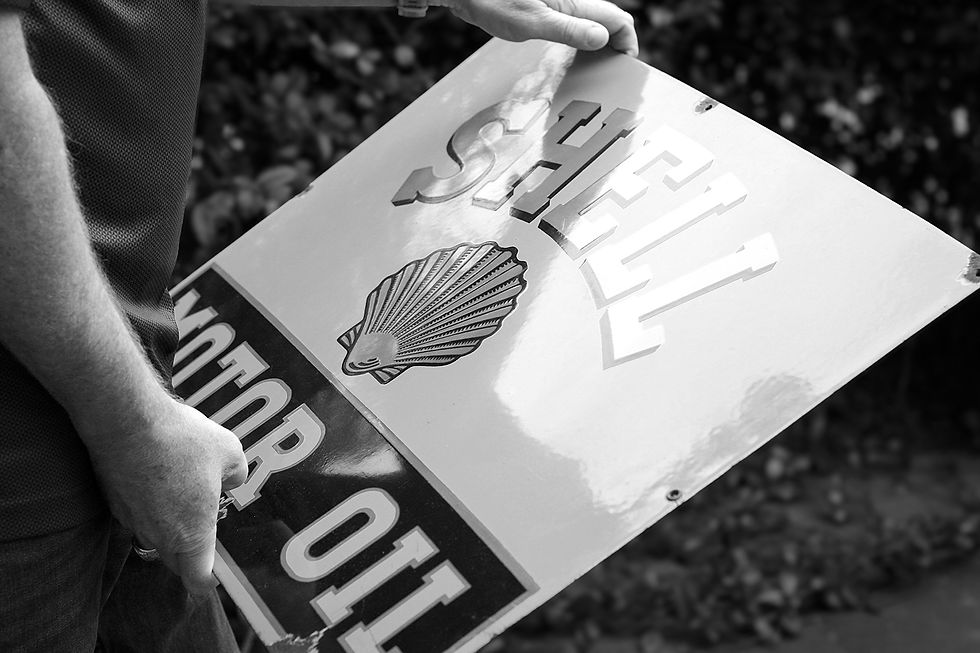
These men - the farmers, the mechanics, the asphalt workers, the old timers who could date a sign by the weight of it and the color of its yellow - they weren't trying to live in the past. I want to be clear about that, because it would be easy to dismiss them that way, and that would be wrong. They weren't nostalgic in the sentimental sense. They were holding on to something specific. The humanness that was slipping as the world moved faster and faster. Something speed could not give back. Something you felt before you were able to articulate it.
They were already grieving when Covid arrived.
Covid closed the shows. Then, Facebook, with the almost orchestrated opportunity, became the place for auctions. And suddenly, men who had spent forty years learning to read a sign with their hands were being asked to navigate dropdown menus and algorithms and fed ads for things that had no idea who they were. Farmers and mechanics and men whose knowledge lived in their bodies, not their usernames, handed a feed and told this was the market now.
They didn't leave the community. But the community moved on, with or without them.
I'm not saying the technology is the villain. It’s not. People follow the money, and the money moved, and that's a fact without a simple moral. eBay entered the industry. Then, tv shows and streaming made the prices strange. Covid accelerated what was already in motion. No single thing erased the shows. It happened slowly enough that most people didn't notice until it was done. The online bidding came first, and suddenly, the auction at the end of the show, the one everyone stayed for, the one that felt like a finale, was out of reach. So we stopped staying for the auction. Then we stopped staying for the whole show. Then we just stopped going.
What was lost wasn’t the buying.
It's the belonging. The old timer whose currency was knowing things, who could tell you the story behind what you were holding before you even had to ask… he's still out there. But the field where he set up under a tree, and a young couple could find him before sunrise and learn something that isn't written down anywhere, that field is harder to find now. Some are gone. Some are smaller. Some are shadows of what they once were.
But some are still there.
And if you know what you lost, you might recognize what's still there while it is. Not to buy. Just to be in the room. To pick something up and feel the weight of it. To let someone who has been doing this longer than you have tell you what you're holding, and to understand that what they're really handing you isn't a sign.
It's the thread.
"The relationship is worth way more than a piece of metal," Robert always says. But I'd add this: the relationships, the slow knowledge, the morning fields, those are the whole inheritance. Not what you own when it's over. What you carried, and what you passed on.
Find the people who still believe that. Sit with them a while.
- Liz Smith


Comments